AI in call centres is no longer a futuristic nice-to-have. It is fast becoming the engine that powers faster resolutions, happier customers, and more motivated agents. Modern ai-driven solutions for call centers amplify what people do best and automate what slows them down, while also enhancing efficiency across channels. Understanding how AI supports seamless omnichannel customer journeys is key to implementing it thoughtfully and ensuring every customer interaction is smooth and effective.
This guide explores how AI is transforming call centres, the practical benefits you can expect, and how to roll it out in a way that delivers measurable results.
Transforming Customer Experience with AI in Contact Centres
Implementing AI in contact centres goes beyond automating routine tasks. By analyzing customer interactions, it helps agents understand individual needs and predict issues before they escalate. For example, advanced computing technologies for AI applications allow contact centres to process massive amounts of data quickly, turning insights into faster, smarter service.
Additionally, AI tools can optimize scheduling, monitor agent performance, and provide real-time suggestions during customer calls. Businesses looking to stay competitive should explore supercomputing resources for enterprise AI to scale these capabilities efficiently. These technologies not only improve response times but also increase overall satisfaction for both agents and customers.
Another essential aspect is aligning AI with marketing strategies. Integrating AI insights into customer-focused marketing campaigns ensures that communication is more personalized and relevant. This creates a seamless journey across every touchpoint, turning a typical service interaction into an opportunity for engagement and brand loyalty.
AI in contact centres also supports better decision-making for managers. Using predictive analytics, teams can anticipate call volume spikes and adjust resources accordingly. Companies relying on data-driven marketing performance tools benefit from seeing a full picture of customer behavior, helping them craft more targeted support strategies.
Finally, finance and operations teams see clear advantages. Leveraging top financial resources for AI-enabled service centers helps in budgeting for technology adoption and calculating ROI, ensuring AI implementation aligns with business goals. When all these pieces come together, AI doesn’t just streamline call handling—it elevates the entire customer experience.
Top 10 Contact Center Solutions for AI in Contact Centres
AI in contact centres is transforming the way businesses engage with customers. Choosing the right platform can improve response times, boost agent efficiency, and enhance customer satisfaction. Here’s a list of the top solutions, with Bright Pattern leading the pack.
1. Bright Pattern: AI-Powered Contact Center Solution
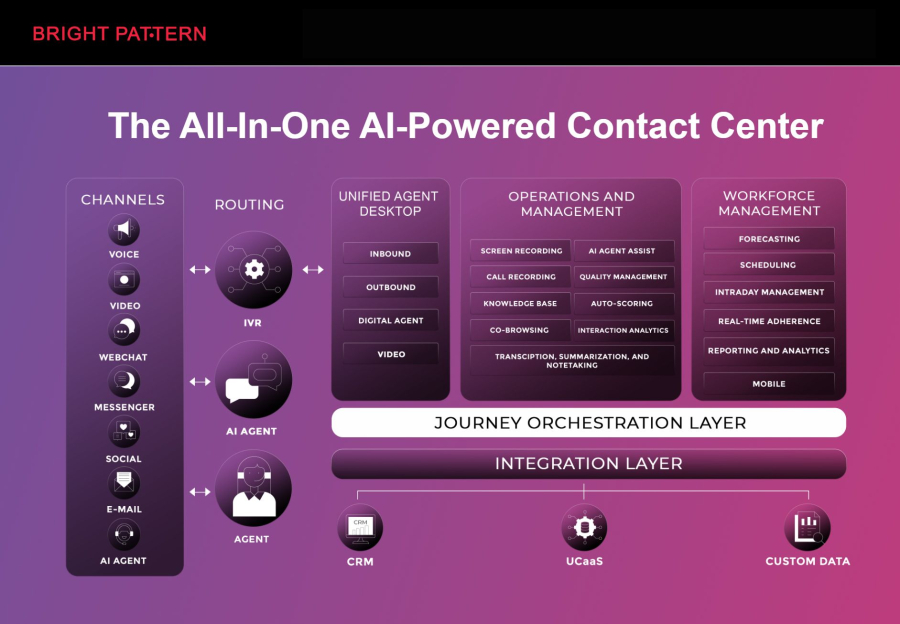
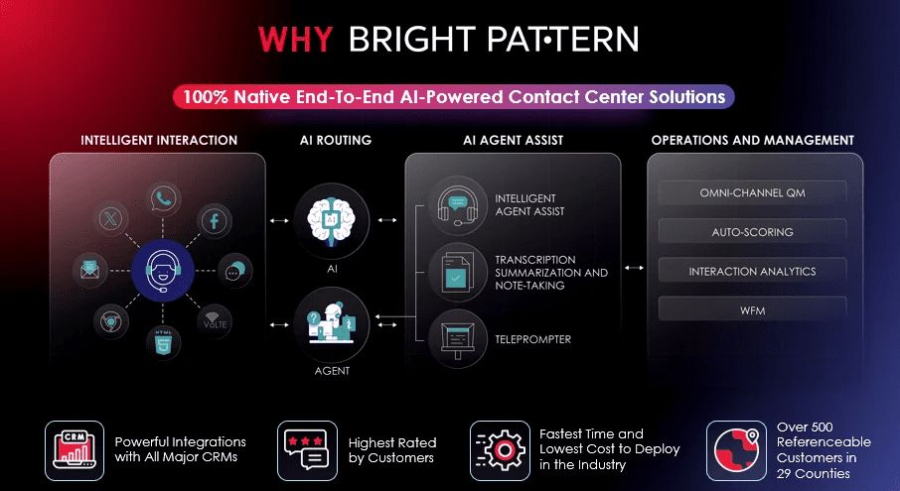
Bright Pattern offers a complete cloud-based contact center platform that leverages AI to optimize every customer interaction. Its features are designed to improve agent productivity, reduce wait times, and ensure seamless omnichannel engagement.
Key highlights:
- AI-driven routing to connect customers to the right agent immediately
- Real-time analytics and reporting for improved performance tracking
- Omnichannel support including voice, chat, email, SMS, and social media
- AI-powered chatbots and virtual assistants to handle routine inquiries
- Easy integration with CRM systems and third-party applications
Bright Pattern’s platform makes it simple to implement AI in contact centres, allowing businesses to scale quickly while maintaining high-quality customer service. Its focus on AI-driven solutions ensures smarter decision-making, faster resolutions, and a consistent experience across all channels.
2. Genesys Cloud CX
Genesys Cloud CX combines AI and automation to deliver predictive routing, conversational AI, and workforce optimization. It is ideal for enterprises looking to enhance customer engagement and agent productivity.
3. Five9 Intelligent Cloud Contact Center
Five9 uses AI to streamline call handling, provide predictive dialing, and support self-service options. Its AI-driven insights help managers make data-informed decisions.
4. NICE inContact CXone
CXone offers cloud contact center solutions with AI-powered analytics, omnichannel routing, and automation. Its platform is suitable for both small businesses and large enterprises.
5. Talkdesk AI Cloud Contact Center
Talkdesk provides AI-assisted workflows, virtual agents, and voice analytics to enhance operational efficiency and customer satisfaction.
6. Cisco Webex Contact Center
Cisco Webex leverages AI for smart routing, automated interactions, and comprehensive reporting, helping teams deliver fast, personalized service.
7. Avaya OneCloud CCaaS
Avaya OneCloud offers AI-enhanced call routing, real-time analytics, and virtual assistants to streamline contact center operations.
8. 8x8 Contact Center
8x8 provides AI-based analytics, omnichannel support, and automated workflows to improve customer experience and reduce agent workload.
9. RingCentral Contact Center
RingCentral combines AI and cloud technology to provide intelligent call routing, workforce management, and reporting tools that enhance service quality.
10. Zendesk Talk
Zendesk Talk integrates AI for smart routing, call analytics, and automated support, enabling teams to deliver faster and more personalized customer interactions.
What Do We Mean by AI in Call Centres?
AI in call centres refers to a set of technologies that analyse language, data and behaviour to automate or enhance parts of the customer service journey. It typically includes:
- Conversational AIthat powers chatbots and virtual agents for voice and messaging.
- Natural language processing (NLP)that understands what customers are saying or typing.
- Machine learning modelsthat predict next best actions, sentiment or likelihood to churn.
- Speech analyticsthat turns voice calls into searchable, analysable data.
- Automation toolsthat handle repetitive tasks in the background.
Used together, these tools create an intelligent layer across your contact centre, guiding interactions, boosting efficiency and unlocking insights that were previously hidden.
Key Benefits of AI in Call Centres
When deployed with a clear strategy, AI can transform your call centre from a cost centre into a growth engine. Here are the standout benefits.
1. Faster Response Times and 24/7 Availability
Customers expect immediate help, at any time of day. AI makes this possible without simply adding more people.
- Instant first responsethrough AI-powered chatbots and virtual agents that greet customers and solve common queries within seconds.
- 24/7 coveragewithout the cost of running a fully staffed night shift.
- Smart routingthat identifies a customer’s intent quickly and directs them to the right agent if human help is needed.
The result is dramatically shorter wait times and a smoother experience at peak moments, such as seasonal surges or unexpected product issues.
2. Higher First-Contact Resolution
AI tools can help agents get to the right answer on the first attempt.
- Knowledge suggestions in real timesurface the most relevant articles or process steps on the agent’s screen as they talk to the customer.
- Context-rich routingpasses information gathered by bots or IVR to the live agent, so customers are not forced to repeat themselves.
- Guided workflowsuse AI to suggest the next best question, action or offer based on similar, successful cases.
Better first-contact resolution not only boosts customer satisfaction, it also reduces call volumes and handling times, creating a virtuous circle of efficiency.
3. More Personal and Proactive Customer Experiences
AI gives your call centre the power to recognise individual customers and tailor support to their situation in real time.
- 360-degree customer viewscombine CRM data, interaction history and behaviour so agents understand the full context behind each enquiry.
- Personalised recommendationssuggest helpful products, services or solutions based on previous interactions and preferences.
- Proactive outreachallows AI to identify at-risk customers or emerging issues and trigger timely messages or calls.
The outcome is a level of personalisation that makes your service feel genuinely human and attentive, even at large scale.
4. Happier, More Productive Agents
AI in call centres is as much about empowering your team as it is about serving customers.
- Reduced admin and data entrythrough automated call summarisation, case creation and after-call notes.
- Real-time coachingwhere AI flags compliance statements to cover, or suggests better language when it detects frustration or confusion.
- Smarter schedulesthanks to AI-driven workforce management that predicts volumes and recommends optimal staffing.
When repetitive work is taken off their plate, agents can focus on problem-solving and relationship-building. This often leads to higher engagement, lower burnout and improved retention.
5. Stronger Quality, Compliance and Insight
Manual call monitoring and quality checks only ever touch a tiny fraction of interactions. AI changes the scale completely.
- Automated quality monitoringscans 100% of calls and chats for key phrases, scripts and compliance requirements.
- Sentiment and emotion analysisdetects frustration, satisfaction and escalation risk in near real time.
- Trend and root-cause analysisspots repeated drivers of contact, allowing you to fix issues at their source.
This level of visibility gives leaders far more confidence in the service being delivered and concrete data to improve products, policies and processes.
6. Lower Costs Without Sacrificing Experience
AI is a powerful lever for reducing cost per contact, while actually improving service quality.
- Deflection of simple queriesto self-service bots and automated journeys.
- Shorter handling timesthrough guidance, automation and better routing.
- Better forecasting and schedulingso you can run leaner teams without overloading anyone.
Instead of growing headcount linearly with contact volumes, AI allows you to scale support more efficiently and reinvest savings into higher-value projects.
Core AI Use Cases in Modern Call Centres
AI can support almost every stage of a customer contact. Below are the most common and impactful applications.
AI-Powered Virtual Agents and Chatbots
Virtual agents handle routine inquiries via voice or chat, such as:
- Resetting passwords or unlocking accounts.
- Checking order status, delivery dates or balances.
- Updating contact details or simple account changes.
- Answering frequently asked questions about products or policies.
Well-designed bots resolve a large share of contacts end to end, while smoothly handing complex cases to human agents along with full context.
Intelligent IVR and Call Routing
Traditional menus can be clunky. AI-driven IVR (interactive voice response) lets customers speak naturally, for example, “I want to upgrade my plan” or “I need to report a lost card”. The AI detects intent and then:
- Routes the call to the most suitable queue or specialist.
- Collects relevant details before the agent joins.
- Offers self-service options where appropriate.
Customers experience fewer transfers, and agents can start each call fully briefed.
Real-Time Agent Assist and Knowledge Suggestions
AI listens to or reads the interaction (according to your policies) and provides in-the-moment support to the agent, such as:
- Suggesting next steps or relevant troubleshooting guides.
- Highlighting policies or regulatory statements to cover.
- Surface upsell or cross-sell offers that fit the customer profile.
Especially for new hires, real-time assist dramatically shortens the time it takes to reach full productivity.
Speech Analytics and Conversation Intelligence
Speech analytics converts calls into text and extracts powerful insights:
- What topics are driving the highest volumes.
- Which scripts correlate with higher satisfaction or sales.
- Where customers are getting stuck in processes or journeys.
- How sentiment changes throughout interactions.
These insights feed back into coaching, product design and customer journey improvements.
Workforce Management and Forecasting
AI models can predict contact volumes by channel and time period, based on historical patterns, campaigns and external events. This helps you:
- Build more accurate forecasts and staffing plans.
- Reduce overstaffing and costly overtime.
- Schedule skills and languages precisely where they are needed.
The result is smoother operations for managers and a more predictable workload for agents.
Automated After-Call Work and Case Management
After-call work is an essential but time-consuming task. AI can automatically:
- Summarise the conversation into clear notes.
- Tag the interaction with the right reason codes.
- Create or update tickets, cases and follow-up tasks.
Shaving even one minute off thousands of interactions quickly adds up to meaningful savings and allows agents to handle more value-adding conversations.
How to Implement AI in Your Call Centre Step by Step
Successful AI adoption is less about technology and more about strategy and change management. The following roadmap helps you roll out AI in a controlled, results-focused way.
1. Clarify Your Objectives
Start with clear, measurable goals. For example:
- Reduce average handling time by 15% within 12 months.
- Increase first-contact resolution by 10 percentage points.
- Deflect 25% of password reset calls to self-service.
- Improve customer satisfaction (CSAT) by 0.5 points.
These targets will guide your choice of use cases and how you measure success.
2. Identify High-Impact Use Cases
Look for processes that are:
- High volumefor maximum impact.
- Structured and repeatableso they are easy for AI to learn.
- Low to medium complexityto build confidence quickly.
Examples include password resets, order status checks, address changes or basic billing queries. Early wins here build momentum for more advanced projects.
3. Prepare Your Data Foundations
AI relies on data quality. Focus on:
- Making sure customer and interaction data is accurate and accessible.
- Standardising reason codes, categories and outcomes.
- Bringing together data from telephony, CRM, ticketing and feedback tools.
The better your data, the more reliable and powerful your AI models will be.
4. Choose the Right Technology Mix
Decide whether to:
- Extend capabilities in your existing call centre platform with AI modules.
- Adopt specialist tools for specific use cases, such as speech analytics or chatbots.
- Use a combination that integrates via APIs.
Prioritise solutions that work well with your current systems and are straightforward for your teams to use and maintain.
5. Pilot, Learn and Iterate
Rather than rolling out AI everywhere at once, run focused pilots.
- Choose one or two high-impact journeys.
- Launch to a limited set of customers or queues.
- Monitor performance daily and gather agent feedback.
- Fine-tune scripts, training data and routing rules.
This test-and-learn approach lets you refine the experience before scaling it across the operation.
6. Bring Your People With You
AI works best when agents see it as an ally, not a threat. Invest in:
- Clear communicationabout how AI will reduce admin and support their success.
- Hands-on trainingso agents know how to use new tools confidently.
- Feedback loopswhere agents can suggest improvements and flag issues.
When your front-line team feels involved, adoption rates climb and the technology delivers far more value.
7. Track Results and Celebrate Wins
Set up dashboards that track key metrics before and after AI implementation. For example:
- Contact volume by channel.
- Average handling time (AHT).
- First-contact resolution (FCR).
- Customer satisfaction (CSAT) and Net Promoter Score (NPS).
- Agent satisfaction and turnover.
Share results widely. Highlight success stories where AI saved a difficult situation, reduced a backlog or helped an agent delight a customer.
Key Metrics to Measure the Impact of AI
To demonstrate the value of AI in your call centre, focus on a balanced scorecard of efficiency, experience and people metrics.
|
Area |
Metric |
What AI Can Influence |
|
Efficiency |
Average handling time (AHT) |
Real-time guidance, automation of repetitive steps, better routing. |
|
Efficiency |
Cost per contact |
Higher self-service, fewer transfers, shorter calls. |
|
Customer experience |
CSAT / NPS |
Faster responses, more personalised support. |
|
Customer experience |
First-contact resolution |
Smarter routing and knowledge suggestions. |
|
Operations |
Containment rate |
Share of contacts resolved fully by bots or self-service. |
|
People |
Agent satisfaction |
Reduced admin, better tools, more meaningful work. |
|
People |
Attrition and absence |
Less burnout through smarter workloads and support. |
Tracking these consistently gives you a clear narrative about how AI is improving your operation and where to focus next.
Practical Tips for Maximising AI Success
To make the most of AI in your call centre, keep these practical guidelines in mind.
Start Simple and Build Confidence
Resist the temptation to automate everything at once. Launch with a few clear, well-designed journeys and expand as you gain data and experience. Small, visible wins build trust across the organisation.
Design With Customers and Agents in Mind
View AI as part of your overall customer and agent experience, not just a back-end engine.
- Use natural, clear language in bots and IVR flows.
- Always provide an easy route to a human when needed.
- Involve agents in testing and refining the AI experience.
This customer- and agent-first mindset ensures AI feels helpful rather than intrusive.
Continuously Train and Improve the Models
AI performance improves with ongoing learning.
- Review transcripts and analytics to find gaps in understanding.
- Update training data regularly with new phrases, products and scenarios.
- Refine routing rules and recommendation logic based on outcomes.
Treat AI as a living part of your operation, not a one-off project.
Align AI With Your Brand and Tone of Voice
Whether it is a chatbot or an agent-assist prompt, your AI touchpoints should reflect your brand personality.
- Define tone guidelines for bots, just as you do for human agents.
- Ensure consistency across channels and regions.
- Review messages and prompts regularly for clarity and warmth.
A well-branded AI experience strengthens trust and reinforces your organisation’s values.
Future Opportunities: Where AI in Call Centres Is Heading
AI capabilities are evolving quickly, opening up even more possibilities for call centres.
- Richer voice experienceswith more natural, conversational virtual agents.
- Deeper personalisationbased on real-time behaviour across digital and physical touchpoints.
- End-to-end journey orchestrationthat connects marketing, sales and service into one seamless experience.
- Predictive servicewhere AI anticipates needs before the customer feels the need to reach out.
Organisations that start building AI capabilities today will be well placed to take advantage of these advances as they mature.
Conclusion: Turning AI Into a Strategic Asset in Your Call Centre
AI in call centres offers a powerful combination of faster service, richer insight and happier teams. By automating routine tasks, guiding agents in real time and delivering always-on support, AI turns your contact centre into a strategic asset rather than a cost to minimise.
With a clear vision, thoughtful implementation and a focus on people as much as technology, you can harness AI to create the kind of service experience that customers remember for the right reasons and employees are proud to deliver.
